
The challenge
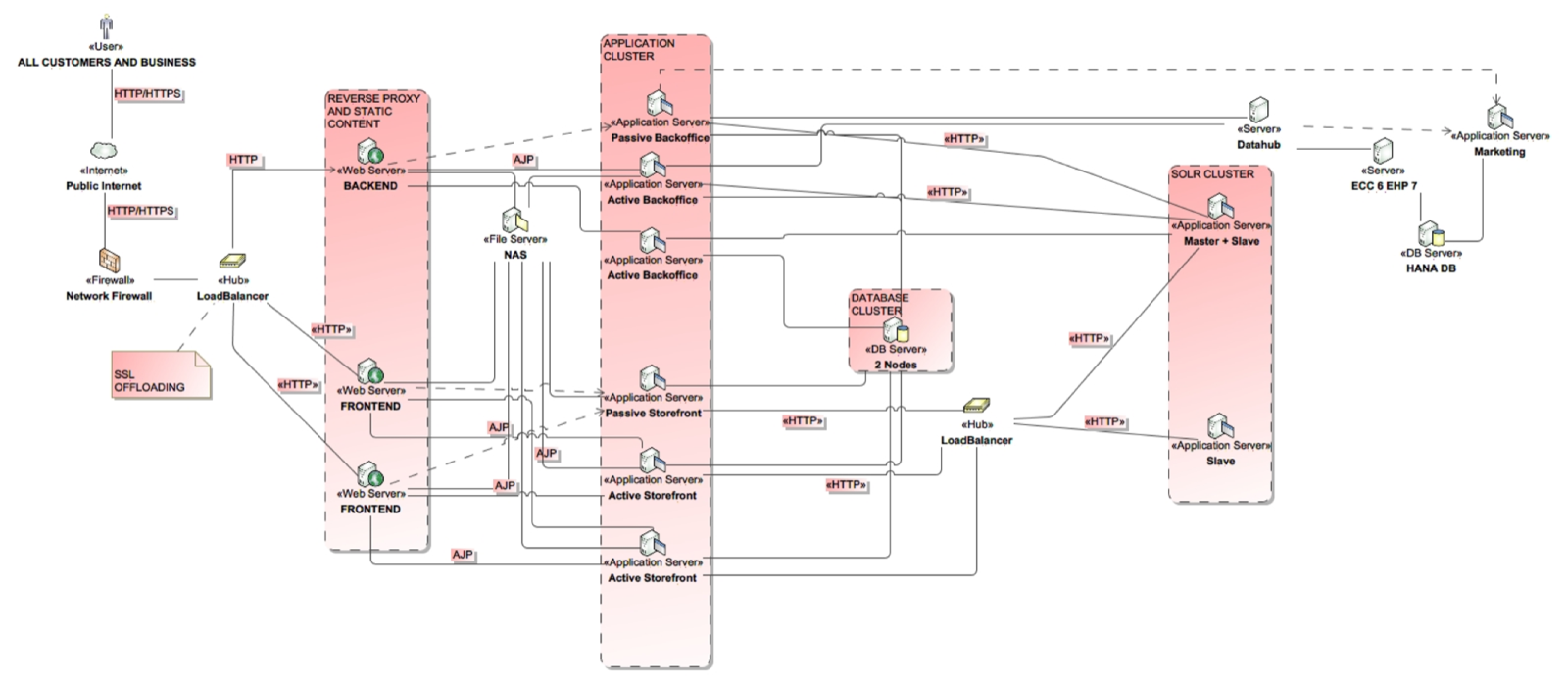
A global manufacturer moving into B2B commerce needed more than a logical design: it needed a physical deployment architecture it could buy hardware against, run in more than one data centre, and hold to a service level. The platform had to front both customer and business users, integrate with core ERP and marketing systems, and carry search — while the organisation was still deciding whether to centralise infrastructure or distribute it by region.
Approach
- Produced a physical deployment architecture — named tiers, node counts and protocols — rather than a conceptual diagram.
- Modelled centralised and decentralised infrastructure as explicit alternatives, each costed and assessed against the same requirements.
- Separated frontend, backend and backoffice tiers with active/passive pairing so maintenance would not mean downtime.
- Wrote non-functional requirements down as a reviewable artefact, so they became testable commitments.
- Produced a landscape recommendation covering the commerce and marketing footprint together.
Innovation
- Treated the infrastructure decision as an architecture deliverable in its own right — most commerce designs stop at the logical view and leave the expensive question open.
- Made non-functional requirements a signed artefact rather than an assumption, which is what let them be tested later.
Outcome
- Deployment architecture delivered and used as the basis for infrastructure procurement.
- Centralised-versus-decentralised decision resolved with a documented rationale.
- Non-functional requirements agreed and recorded ahead of build.
- Landscape recommendation delivered across commerce and marketing.
Recommendations
- Take the logical design through to a physical one. A conceptual architecture cannot be procured, staffed or tested against.
- Answer the centralised-versus-decentralised question early and in writing. It is the decision with the longest shadow over cost and failover.
- Write the NFRs down before build. Unwritten non-functionals are discovered during performance testing, which is the most expensive place to find them.
- Design active/passive pairs into the tiering, or accept that routine maintenance will mean downtime.
Architecture

Technology
- SAP Commerce (hybris)
- Apache SOLR
- SAP Data Hub
- SAP ECC / HANA
- SAP Marketing
- Reverse proxy / load balancing